Model · June 10, 2026
How to Enter Unicorn Trades: Setting Your Entry and Stop Loss
One of the most common questions we get when trading unicorn setups is simple: how do we actually execute? Specifically, where do we enter, and where do we place our stop loss? In this post, we'll break down the two main approaches to setting your stop loss, and cover the general rule for timing your entries. Let's start with entries since they're the most straightforward piece of this.
Getting the Entry
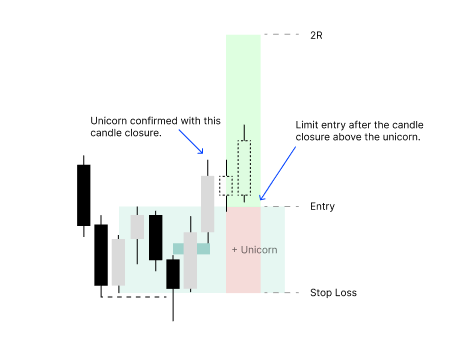
To enter a unicorn trade, the first requirement is a confirmed unicorn. A confirmed unicorn is one where a candle has closed on the same timeframe as the unicorn above the unicorn level in a bullish setup, or below it in a bearish one. That close is your signal that the setup is valid.
Once you have confirmation, you don't chase the move. Instead, you set a limit order and wait for price to retest the unicorn level. That retest might come immediately at the next candle's open, or price may run away and return to the level later. Either way, patience is the edge. You're waiting for price to come to you, not the other way around.
Of course, this is the ideal approach. Every trader can adapt it to their own style or find a method that suits them better.
Setting Your Stop Loss
Now that we know how to get into a position, let's talk about where to place your stop loss. There are two main ways to approach this.
Option 1: Using the Breaker Range
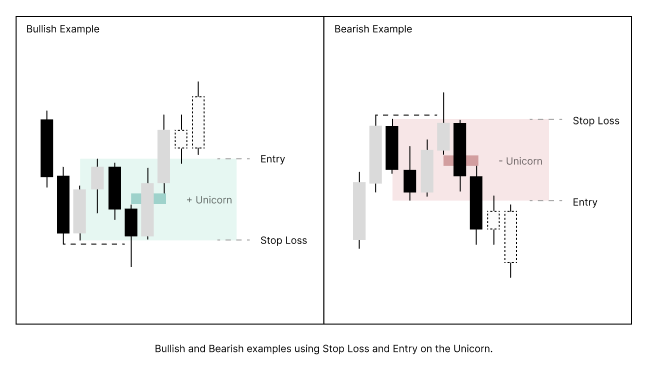
The first method uses the breaker range for both your entry and your stop loss placement. In a bullish unicorn setup, your entry sits at the top of the unicorn and your stop loss sits at the low of the unicorn. The range of the breaker itself defines your risk on the trade.
Option 2: Using the Swing High/Low Invalidation
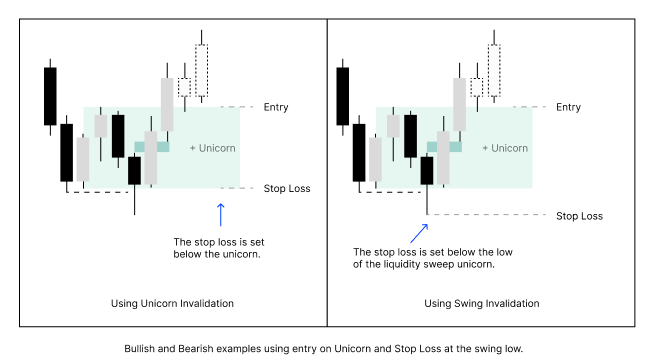
The second method places your stop loss at the swing low or swing high that took liquidity, rather than within the breaker range itself. This gives your trade more room to breathe and defines your stop based on the point where the setup would be fully invalidated.
To make the difference between these two methods clearer, let's look at them side by side through a visual example.
Which Method Works Better?
Based on statistical backtesting, using the unicorn itself for both entry and stop loss has proven to be the more successful approach overall. While the swing low/high method has its place, the numbers favor keeping your risk defined within the breaker range.
That said, there is room to refine this further. Developing a clear rule for when to apply one method over the other could potentially improve results beyond what either approach delivers on its own. Finding that optimal condition is where a trader can really start to personalize the strategy to their edge.